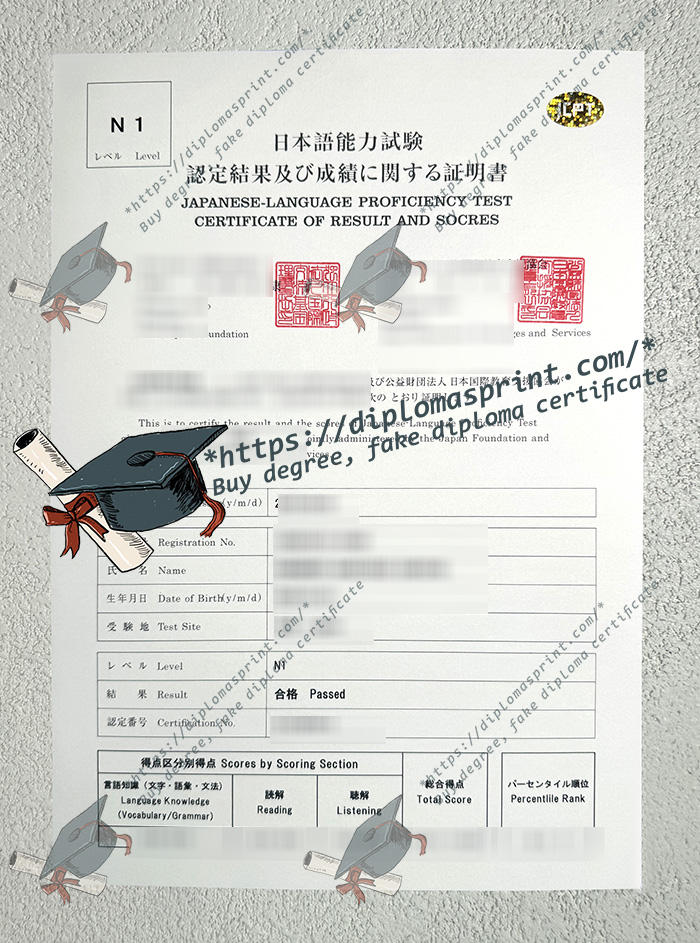
Sell top quality JLPT Transcript, Japanese-Language Proficiency Test Transcript, Get JLPT N1 Academic record online, The Japanese-Language Proficiency Test (JLPT) is the most widely recognized standardized test for evaluating and certifying the Japanese language proficiency of non-native speakers. It is jointly administered by the Japan Foundation and Japan Educational Exchanges and Services (JEES) and is held twice a year in many countries. While much attention is often given to the test itself—its structure, difficulty levels, and preparation strategies—understanding the JLPT Academic record, officially known as the Test Result and Credentials of Proficiency, is equally important. This essay provides a comprehensive introduction to the JLPT Academic record, its components, significance, uses, and what it means for test takers. Get JLPT N4 Certificate.
1. What Is the JLPT Academic record?
The JLPT Academic record, also referred to as the “Test Result Notification” or “Score Report,” is the official document issued to every test taker after completing the JLPT. Regardless of whether the test taker passes or fails, this Academic record provides a detailed account of their performance on the exam. For those who pass, an additional Credentials of Proficiency is provided. These Papers serve as formal proof of a candidate’s Japanese language abilities and are recognized by academic institutions, employers, and government agencies both in Japan and internationally.
2. Structure of the JLPT Academic record
The JLPT Academic record is standardized across all five levels of the test, from N5 (beginner) to N1 (most advanced). The Academic record typically includes the following key components:
A. Personal Information
-
Name of the test taker
-
Test level (e.g., N3, N2, etc.)
-
Examinee registration number
This section identifies the individual and confirms the specific JLPT level taken.
B. Overall Result
-
Clearly states Pass or Fail
To pass the JLPT, a candidate must achieve both the overall passing score and meet the minimum score requirements for each test section.
C. Score Breakdown
-
Language Knowledge (Vocabulary/Grammar)
-
Reading
-
Listening
-
Total score (out of 180 points)
Each section is graded individually and contributes to the total score. This detailed breakdown helps the candidate understand their strengths and weaknesses.
D. Reference Information
-
Performance levels are also presented as A, B, or C:
-
A – Excellent
-
B – Average
-
C – Needs Improvement
-
This grading provides a qualitative assessment of performance in different skill areas and is especially helpful for understanding readiness for higher-level tests or real-world use.
3. Credentials of Proficiency
In addition to the Academic record, candidates who pass the JLPT at any level receive a Credentials of Proficiency. This Credentials is a formal recognition of Japanese language proficiency and is typically printed on high-quality paper, suitable for job or academic applications. It includes:
-
Candidate’s name
-
Level passed (e.g., N2)
-
Date of examination
-
Signature/stamp of the issuing authority
While the Academic record shows detailed performance data, the Credentials is a clean, official document used for formal purposes.
4. How and When Are Results Delivered?
The JLPT is typically administered in July and December each year. The results and transcripts follow a set release timeline:
-
Online Results: Available on the official JLPT website approximately 1–2 months after the test.
-
Physical Academic record & Credentials: Mailed to test takers 2–3 months after the test date, depending on the region.
Candidates must ensure that the address they provide during registration is accurate to avoid delays or loss.
5. Uses and Importance of the JLPT Academic record
The JLPT Academic record is more than just a record of exam results; it has real-world value across multiple sectors:
A. Academic Applications
Many universities in Japan require a minimum JLPT level (often N2 or N1) for admission into Ja
B. Employment
For job seekers, especially those applying to companies in Japan or Japanese-speaking environments, the JLPT Academic record demonstrates formal language proficiency. Some employers require proof of JLPT scores as part of the hiring process.
C. Immigration and Residency
In Japan, certain immigration categories—such as nursing care workers, technical interns, or those applying for permanent residency—may require proof of JLPT N2 or N1. The Academic record and Credentials serve as documentation for Travel document and immigration processing.
D. Personal Achievement
For many learners, the JLPT Academic record provides a sense of accomplishment and a tangible record of their progress in mastering the Japanese language. It can be a valuable milestone on their language learning journey.
6. Interpreting the Scores
Understanding what your JLPT scores mean is essential. Each level has a total score range of 0–180. To pass, test takers must meet both:
-
A total passing score (e.g., 90/180 for N3)
-
A minimum score in each section (e.g., at least 19/60 in Listening)
Failing to meet the requirement in any section results in an overall fail, regardless of how high the total score is.
The A–B–C reference levels help further interpret how well a student performed, offering insight beyond the raw score. For instance, a “C” in Listening suggests the need for more real-world audio practice, even if the total score is high enough to pass.
7. Conclusion
The JLPT Academic record is a vital document for anyone pursuing Japanese language proficiency for academic, professional, or personal reasons. It not only certifies the level of achievement but also provides a detailed breakdown of skills in vocabulary, grammar, reading, and listening. Beyond its practical applications, the Academic record serves as a milestone that reflects dedication, effort, and progress in learning the Japanese language. Understanding how to interpret and use this document is key to maximizing the benefits of taking the JLPT. Whether you are applying for a university program, seeking a job, or simply tracking your language learning journey, the JLPT Academic record stands as a reliable and respected certification of your Japanese proficiency.